

Prague Astronomical Clock: Secrets of a 600-Year-Old Time Machine
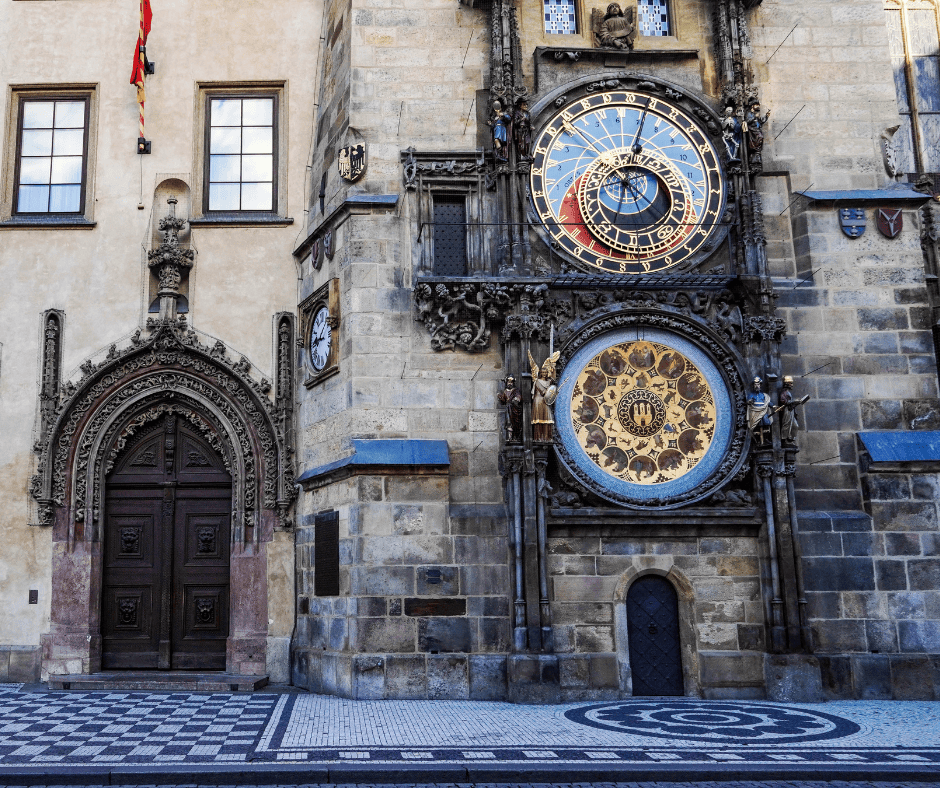
Ever stood before the Prague Astronomical Clock (Orloj) in the heart of Old Town Square, transfixed by its ticking figures and ancient face — wondering how this 600-year-old wonder shows four different times, moon phases, and zodiac signs all at once?
Hi, I’m Valery from Real Prague Guides (100 Spires City Tours), your local storyteller and history nerd. In this post, I’ll decode Prague’s most fascinating landmark — its mechanics, history, legends, and a few insider tips for 2026, so you can impress your friends when you visit.
How the Astronomical Clock Works
The Prague Astronomical Clock has two main dials — the upper astrolabe (a medieval sky tracker) and the lower calendar. The upper part displays time, celestial motion, and even the Sun and Moon’s position, while the lower dial acts as a full-year medieval calendar.
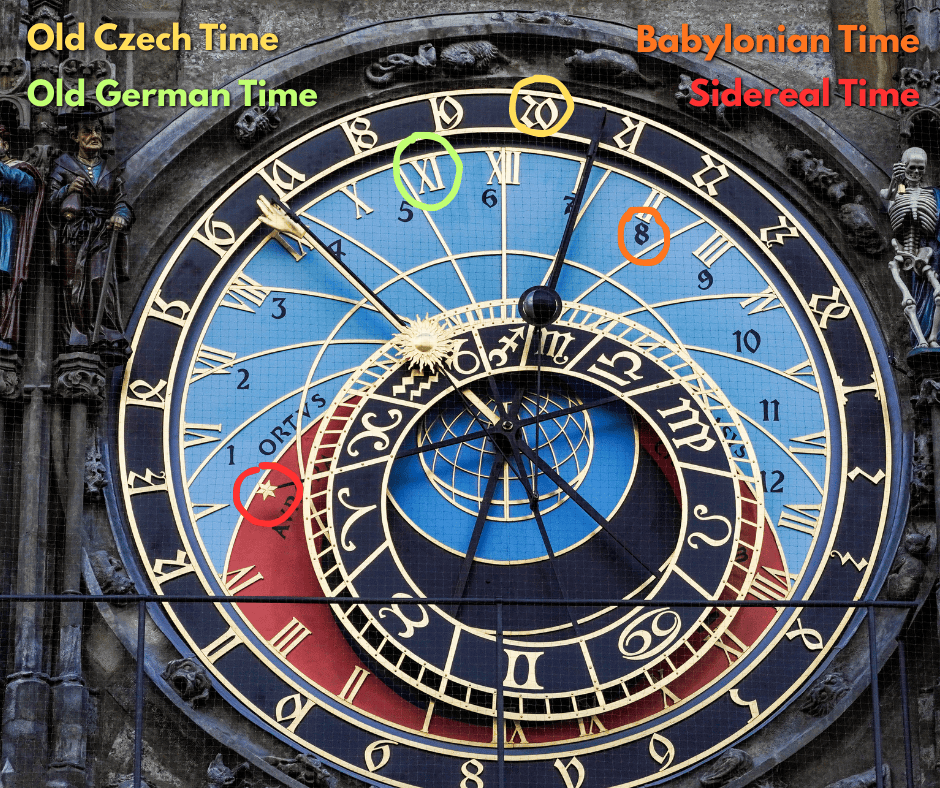
The Upper Dial: Four Ways to Tell Time
This masterpiece shows not one, but four different time systems — a true marvel of 15th-century engineering.
Old Czech (Bohemian) Time: The gold Gothic numbers around the edge show sunset-based time — 24 hours from dusk. Back in the 1400s, locals counted time this way.
Old German (Roman) Time: The familiar Roman numerals represent our classic 12-hour cycle — the best option if you actually want to know the current hour.
Babylonian Time: Follow the golden Sun marker between the curved lines — this system divides daylight into 12 unequal hours. Longer summer days mean wider “hours.”
Sidereal (Star) Time: Astronomers’ favorite. It’s a 24-hour clock that runs about 4 minutes behind solar time, matching the rotation of the stars.
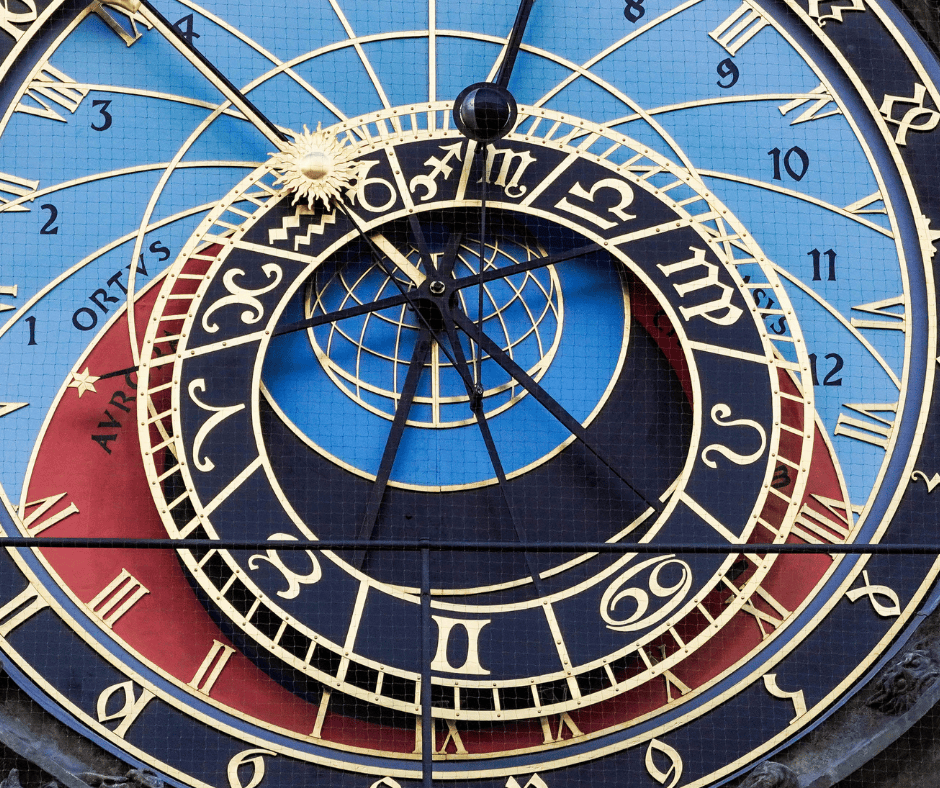
Celestial Tracker: The Sky on a Clock Face
At the clock’s center sits Earth, as it was believed to be the center of the Solar System at that time.
Around it spins the zodiac ring, showing the Sun’s position among zodiac signs. In early February, the Sun moves through Aquarius, shifting toward Pisces mid-month. The Moon ball — silver and black — completes its orbit every 27.5 days, rotating to show its current phase.
The dial’s background shades through blue and black to represent dawn, rising, setting, and twilight, all labeled in Latin: Aurora, Ortus, Occasus, Crepusculum. Watching it feels like observing a miniature universe in brass.
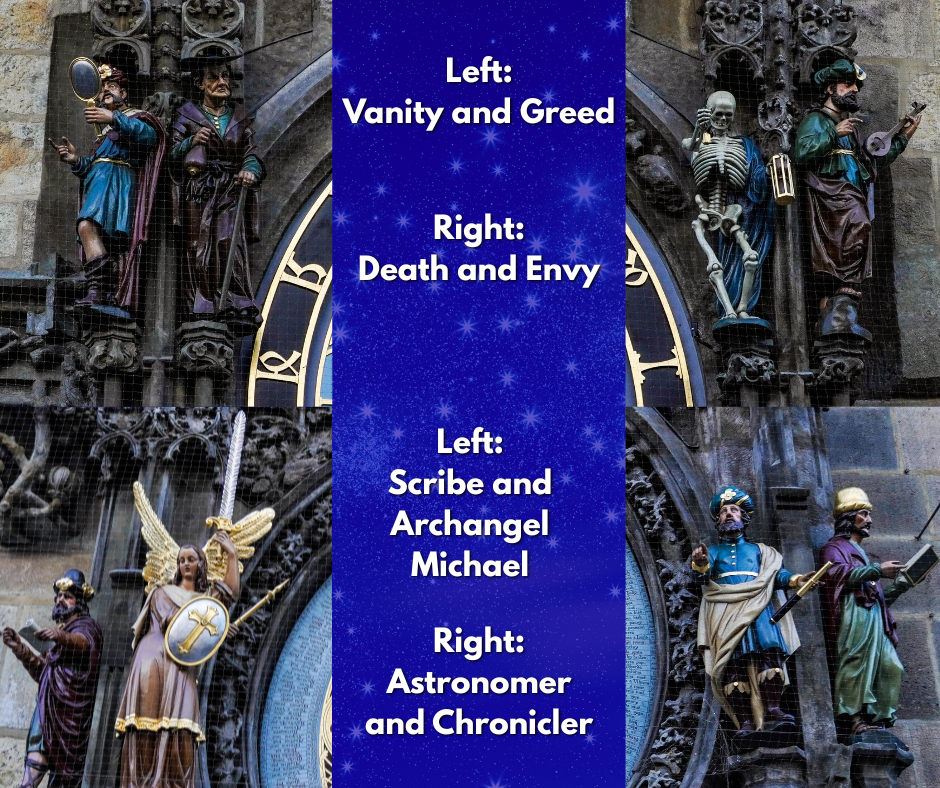
The Hourly Apostle Show and Moving Figures
Every hour on the hour between 8:00 AM and 11:00 PM, crowds gather for the Apostles’ Parade, aka the Clock Show — the clock’s most famous performance. Four moving statues beside the dial represent Vanity (a man holding a mirror), Greed, Death (the skeleton with the ringing bell), and Envy.
Then, the blue doors above open, revealing the twelve apostles who march past tiny windows. The performance ends with a triumphant rooster crow and the ringing of the hour. It lasts only about 45 seconds, so arrive at least 10 minutes early for a good view.
The bottom figures of Scribe, Archangel Michael, Astronomer, and Chronicler do not move.
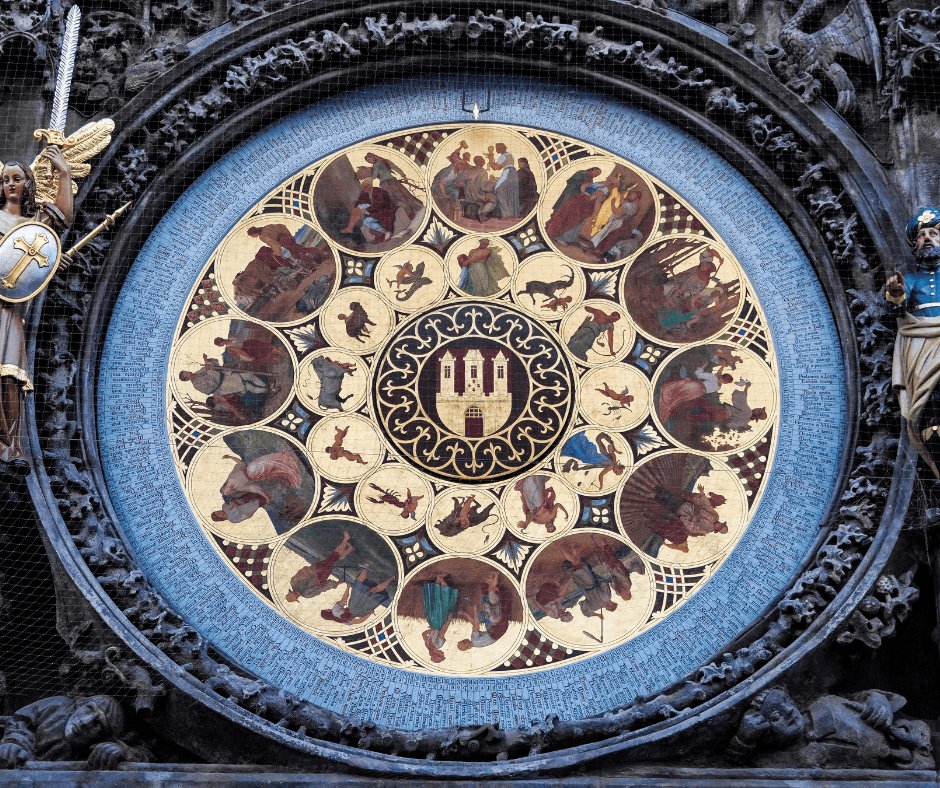
The Lower Dial: Prague’s Medieval Calendar
The lower dial is a 365-day circular calendar with a golden arrow marking today’s date. The outer ring lists saints’ feast days, which were once used to plan medieval fairs and church holidays.
Each month is beautifully illustrated with seasonal scenes — from January feasting to July harvesting. At the center, you’ll spot the emblem of Prague, symbolizing civic pride during the city’s medieval golden age.
History and Legends of Prague’s Orloj
The Astronomical Clock was completed around October 9, 1410, built by clockmaker Mikuláš of Kadaň and astronomer Jan Šindel. This makes it the oldest still functioning clock of this type in the world!
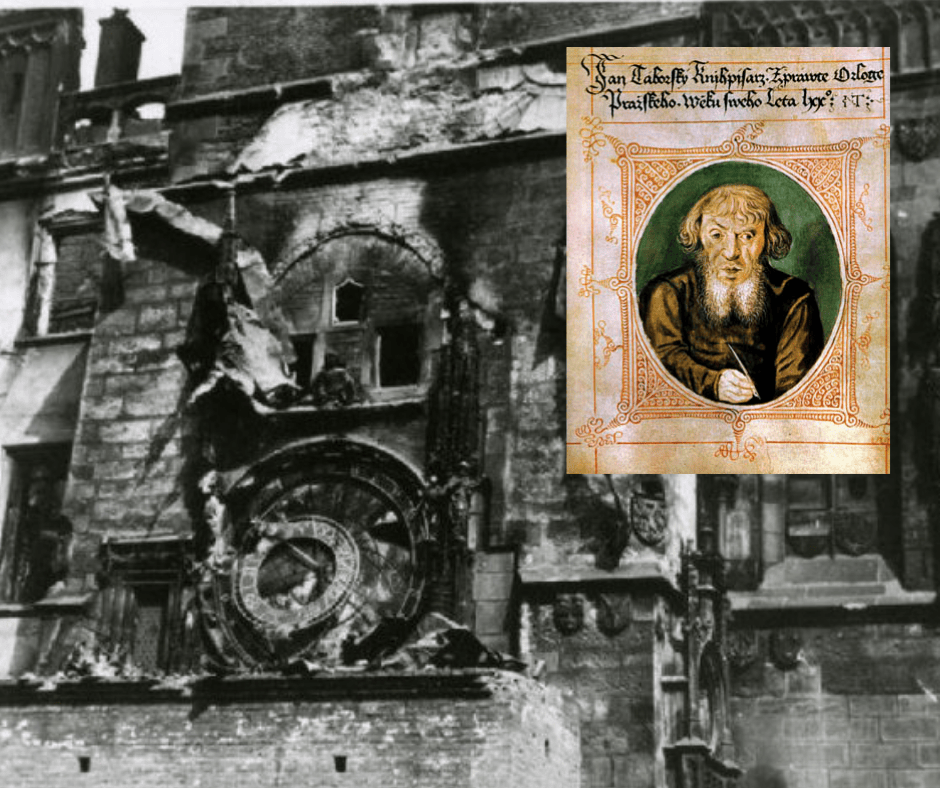
Centuries of legends surround it. The most famous tells of Master Hanuš, whom jealous Prague officials allegedly blinded so he could never recreate his masterpiece. The Orloj stopped working when it was damaged during the Hussite Wars. Master Hanuš, known as Jan Růže, restored it, repairing the astrolabe into the form we know today. The allegories were likely installed in 1659, and in 1866 the saints as well as the golden rooster were added. Regarding the mechanism of the clock, the first major restoration was carried out in 1787–1791 by Šimon Landsperger. Josef Mánes also painted a new calendar in the 19th century, and his design can still be found on the Old Town Hall tower.
During WWII, the clock narrowly survived the 1945 Old Town Hall fire, later restored again under the postwar government. In 2018, a digital safety system was added to protect its gears from damage. The current clockkeeper Petr Skála visits it several times a week for a regular check-up.

Visiting Tips for 2026
Catch the show on the hour between 8 AM and 11 PM — morning shows have fewer crowds.
Arrive 10 minutes early; the performance is short.
Visit the Old Town Hall Tower for an epic view of Prague’s rooftops and check out the digital clock model.
Take advantage of the early bird 50% discount for the tower available between 9 AM and 10 AM!
The mechanism of the clock is not accessible to the public.
The Prague Astronomical Clock is not just an instrument of time — it’s a living symbol of the city’s soul. Six centuries later, it still reminds us that science, art, and myth can tick together in perfect harmony.
FAQ: Prague Astronomical Clock
How old is the Prague Astronomical Clock?
The Prague Astronomical Clock dates back to 1410, which makes it more than 600 years old and one of the oldest working astronomical clocks in the world.
What does the clock actually show?
It shows time, the Sun and Moon’s position, moon phases, zodiac signs, and a calendar dial, so it functions as both a clock and a medieval astronomical instrument.
When does the clock show the apostles?
The apostles appear every hour on the hour during the normal visiting hours, which is why crowds gather in Old Town Square to watch the show.
What is the best time to visit the clock?
Early morning is usually best if you want smaller crowds, while the top of the hour is best if you want to see the moving figures.
Can you go inside the clock?
You can visit the Old Town Hall Tower nearby, but the clock mechanism itself is not open to the public.
WRITTEN BY VALERY
Licensed Prague guide and co-creator of Real Prague Guides (50K+ YouTube subscribers). My company, 100 Spires City Tours, leads some of the highest-rated tours in Prague.
📷 Instagram: @realpragueguides
📺 YouTube: Real Prague Guides
🎫 Book a tour: tours-prague.eu
Disclaimer: This article reflects the personal opinions of the author and is not intended to discourage visitors to Prague from businesses mentioned above.