

Is Prague Still Affordable to Live In? Housing Costs, Rental Challenges, and What Newcomers Should Know
For many years, Prague has attracted newcomers with its history, culture, job opportunities, and central European location. It can still offer a high quality of life, but housing has become a major concern for many residents — particularly renters, young professionals, students, and families hoping to buy their first home.
As a Prague resident for more than 13 years, I have seen the city change quickly. Finding a suitable apartment has become more competitive, rents have risen, and some residents are looking beyond Prague for lower housing costs or more space. Prague can still be a rewarding place to live, but newcomers should arrive with realistic expectations and a clear housing plan.
Is housing in Prague affordable?
Prague is increasingly expensive relative to local incomes, especially for people trying to buy their first home. Although the average net income per household member in Prague is higher than the Czech national average, high rent and other housing expenses can significantly reduce that advantage, according to reporting on Prague’s housing pressures.
More than one-third of Prague households reported difficulty making ends meet in 2023, while around 14 percent said they could not cover an unexpected expense of approximately CZK 15,600, according to figures cited in Expats.cz’s report on housing-driven migration from Prague.
Housing affordability is shaped by several connected factors: high purchase prices, mortgage costs, limited supply, slow construction, and strong demand. Changes to Czech building rules are intended in part to make housing development and renovation processes more effective, though legal reform alone will not immediately solve Prague’s housing shortage. Read more about the Building Act changes here.
What does rent cost in Prague?
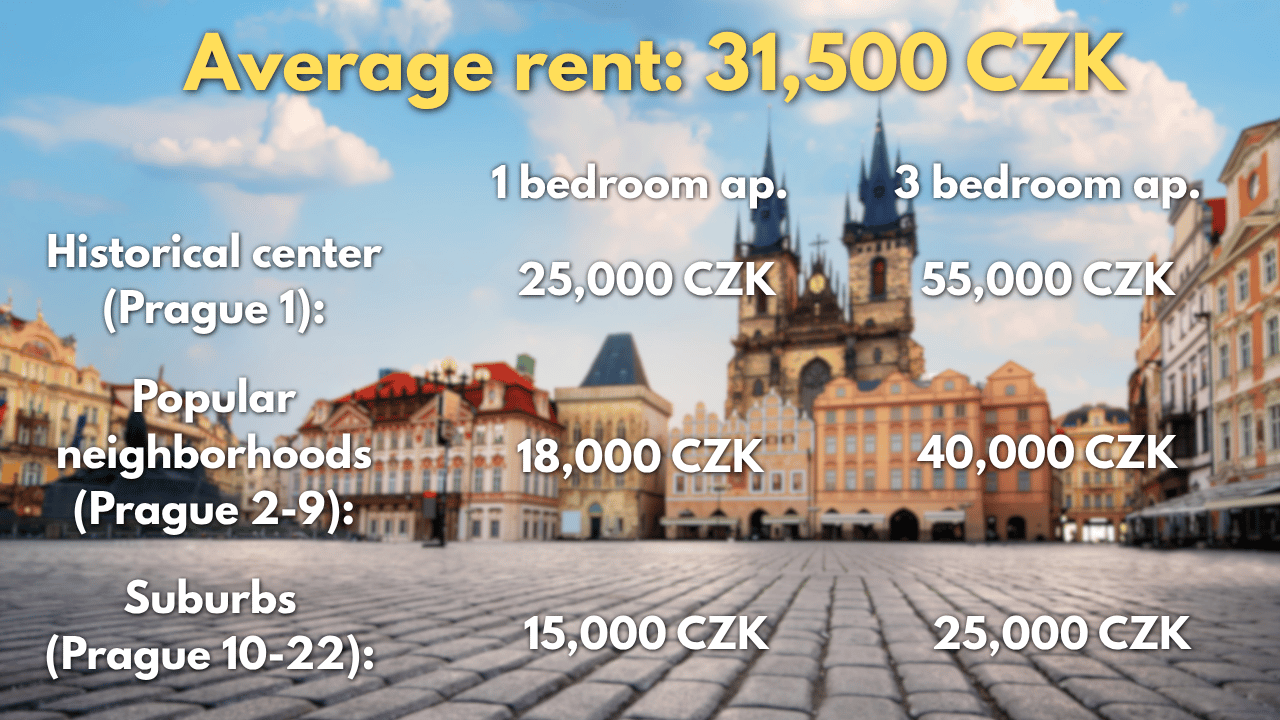
Rent in Prague varies widely by neighbourhood, apartment size, condition, and whether utilities are included. A recent report put the average monthly rent in Prague at close to CZK 31,500, but tenants should always check what that figure includes before comparing listings. See the underlying discussion and context here.
Central and popular residential neighbourhoods, including Vinohrady, Karlín, Žižkov, Holešovice, Smíchov, and parts of Prague 1, are generally more expensive than outer districts or towns beyond Prague’s boundary. A renovated flat in a highly sought-after area can cost far more than a comparable property farther from the centre.
Do not calculate your budget from rent alone. Also consider:
Electricity, gas, water, heating, internet, and building-service charges.
A security deposit, usually required before moving in.
A possible real-estate agency fee.
Furnishing and move-in costs.
Transport costs if choosing a cheaper home farther from central Prague.
The most affordable listings may attract many applicants and disappear quickly. This creates pressure to decide fast, but tenants should never transfer money or sign a contract until they have confirmed the flat, landlord, and complete rental terms.
Is renting harder for foreigners?
Foreigners can face additional rental challenges in Prague, especially when they do not speak Czech or do not know local rental practices. Language barriers can make it more difficult to compare prices, understand contracts, and challenge questionable lease terms.
Some landlords may prefer applicants who can communicate in Czech, provide local employment documentation, or show a local rental history. These experiences vary, but newcomers should be prepared for a more complicated search than they may expect.
For a new arrival, shared housing, student accommodation, or a temporary rental may be a sensible first step. It gives you time to compare neighbourhoods, understand transport connections, and avoid rushing into a long fixed-term agreement.
Many Prague leases are fixed-term contracts, often lasting one or two years. Before signing, check the renewal process, notice period, all fees, and any conditions under which rent may change.
How can foreigners protect themselves when renting?
The lease agreement and move-in process matter as much as the apartment itself. Czech tenant protections can still apply even if a lease includes a clause that appears to limit them. Foreigners.cz provides a useful overview of tenant rights in Czechia.
View the apartment in person, or use someone you trust.
Confirm who owns the property or is legally entitled to rent it out.
Make sure the written lease clearly states rent, deposit, utilities, service charges, duration, and notice period.
Photograph the apartment and existing damage before moving in.
Request an inventory of furniture, appliances, and keys.
Keep payment confirmations and important messages in writing.
If you pay advance utility charges, request the annual settlement showing actual charges, overpayments, or underpayments. Learn more about utility settlements and tenancy terms.
A landlord should not enter a rented flat freely during the tenancy; visits should normally be arranged in advance except in an emergency. See the tenant-rights guidance here.
If you do not understand the contract, ask a Czech-speaking professional or tenant-rights organization to review it before signing.
A valid residential lease will generally allow a tenant to register their address at the property. However, rules can differ for spaces officially registered as non-residential units, such as an ateliér. See the practical explanation here.
Foreign renters who believe a landlord is acting unfairly may also find useful context in this Expats.cz report on tenancy disputes and challenges faced by foreigners.
Do short-term rentals affect Prague residents?
Short-term accommodation contributes to pressure in some parts of Prague, but it is only one element of a wider housing problem. In Prague 1 and other visitor-heavy areas, residents may experience more tourist traffic, noise, and homes used for short stays instead of long-term living.
Housing difficulty is also tied to limited construction, investment demand, high purchase prices, and the mismatch between housing costs and local incomes. Prague’s housing supply is influenced by the speed and complexity of development approvals, which is why the recent Building Act overhaul has been closely watched.
New apartments in Prague averaged approximately CZK 168,000 per square metre in 2025, despite a substantial year-on-year increase in sales during the first quarter, according to the housing-market data discussed in this Expats.cz article.
Why are some people leaving Prague?
Some people move beyond Prague for financial reasons, while others are looking for more space and a quieter lifestyle. Analysts have identified signs of “deurbanisation,” as younger people seek more affordable housing outside Prague while continuing to commute to jobs in the capital. Read the reported data and analysis here.
The surrounding Central Bohemian Region has experienced strong population growth since 2006, reflecting Prague’s wider influence on its commuter belt. The same report explains the regional population trend.
Moving out can bring lower costs and larger homes, but it can also mean longer travel times and greater reliance on regional trains, buses, or cars.
What should newcomers expect?
Prague is still attractive, but newcomers should not expect cheap central housing. Set a realistic budget, compare several neighbourhoods, calculate the full monthly cost, and allow enough time for the apartment search.
Living farther from the centre does not necessarily mean poor access. Prague’s metro, tram, and train network makes many outer districts and nearby towns practical choices, especially for people who prioritize space or lower rent over being within walking distance of Old Town.
Prague’s appeal is real, but its old reputation as a low-cost European capital is no longer enough to plan around. Newcomers should treat housing research, careful lease checks, and full-cost budgeting as essential parts of preparing for a move.
WRITTEN BY VALERY
Licensed Prague guide and co-creator of Real Prague Guides (50K+ YouTube subscribers). My company, 100 Spires City Tours, leads some of the highest-rated tours in Prague.
📷 Instagram: @realpragueguides
📺 YouTube: Real Prague Guides
🎫 Book a tour: tours-prague.eu
Disclaimer: This article reflects the personal opinions of the author and is not intended to discourage visitors to Prague from businesses mentioned above.